A soulful Haziri on the legendary singer’s 52nd death anniversary celebrates her timeless music, artistic legacy and deep connection with Lucknow.
Lucknow: The timeless melodies of Begum Akhtar returned to resonate in the city she so deeply enriched as Lucknow Bioscope and Takshila Education Society organised ‘Remembering Malika-e-Ghazal – Begum Akhtar’, a special musical Haziri at her mazaar in Pasand Bagh, Thakurganj, on the occasion of her 52nd death anniversary. Supported by Saraca Hotel Lucknow as the hospitality partner, the gathering brought together music lovers and admirers to celebrate the extraordinary legacy of one of India’s most cherished ghazal exponents.
The annual Haziri, a musical offering in remembrance of the legendary vocalist, has been held at her mazaar since 2014. This year’s programme marked its thirteenth edition, continuing a tradition that honours Begum Akhtar through the very art form that defined her life.
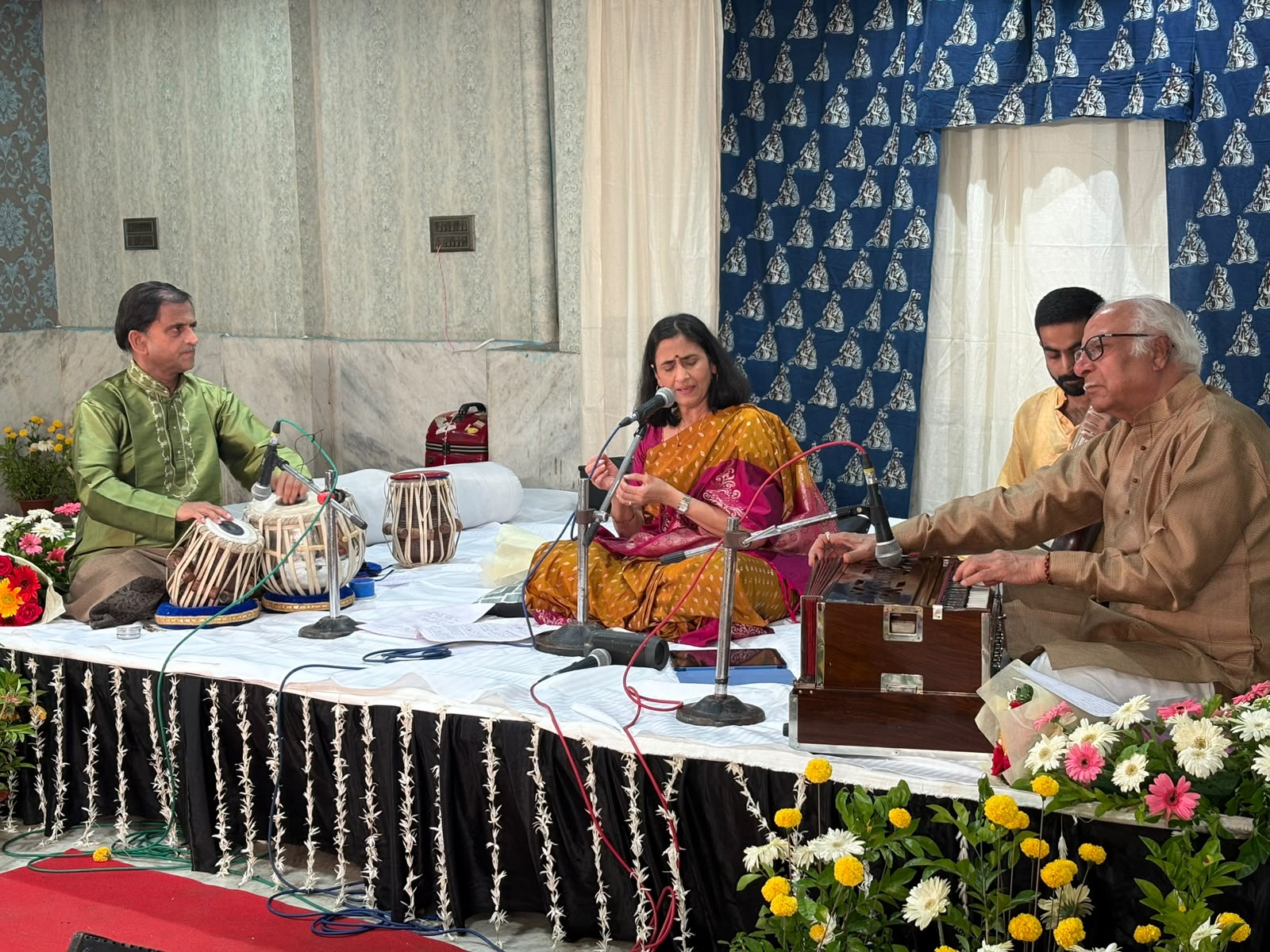
The Haziri was presented by renowned Hindustani classical vocalist Dr Sangita Nerurkar, accompanied by Pandit Vinod Lele on the tabla, Pandit Dharam Nath Mishra on the harmonium and Vinayak Sahai on the sarangi. Together, the musicians created an intimate atmosphere steeped in classical elegance, poetic expression and heartfelt remembrance.
Before the performance, Dr Nerurkar visited Begum Akhtar’s mazaar and paid her respects by singing ‘Sawan Ghar Aa Ja’. The gesture added a deeply personal dimension to the tribute, connecting the contemporary performance with the memory of the legendary artist. The musical presentation began with ‘Itna To Zindagi Mein Kisi Ki Khalal Pade’, followed by ‘Sawan Ghar Aa Ja’ and other memorable ghazals that traced the musical journey of Begum Akhtar.
Through the carefully chosen compositions, Dr Nerurkar revisited the evolution of the singer from Akhtari Bai Faizabadi to the celebrated Malika-e-Ghazal, bringing alive the distinctive musical sensibility that made her an enduring icon.
Expressing her emotions about performing at the historic venue, Dr Nerurkar said, “I feel overwhelmed yet humbled to be performing at the Haziri.”
Reflecting on Begum Akhtar’s artistry, she observed that the legendary vocalist possessed an exceptionally beautiful voice and demonstrated the importance of singing with sincerity and uninhibited expression. Her rigorous grounding in classical music enabled her to weave poetry into diverse rhythmic patterns with remarkable finesse.
Dr Nerurkar further explained that the interplay of raga phrases and poetic couplets brings out the true essence of a ghazal. It was Begum Akhtar’s ability to understand the underlying emotion of a composition and communicate it through her distinctive style that made her performances so fascinating. This individuality remained evident throughout her journey, from her early years as Akhtari Bai to her later identity as Begum Akhtar, setting her apart from her contemporaries.
The enduring legacy of the Malika-e-Ghazal
Born as Akhtari Bai Faizabadi, Begum Akhtar occupies an exceptional place in the history of Indian classical and semi-classical music. Her artistry brought together the emotional depth of Urdu poetry, the intricacies of Hindustani classical music and the expressive beauty of ghazal, thumri and dadra.
Lucknow played a significant role in her artistic and personal journey. The city became an important part of her musical identity, and her association with its cultural traditions helped shape a legacy that continues to inspire generations of musicians and listeners.
Over the course of her career, she composed and performed nearly 400 ghazals, many rooted in classical ragas and distinguished by her extraordinary command over melody, rhythm and poetic interpretation. Her renditions of celebrated poets, including Mirza Ghalib, Jigar Moradabadi and Faiz Ahmad Faiz, remain treasured musical interpretations. Compositions such as ‘Na Socha Na Samjha Na Jaana Na Seekha’ and ‘Nakaami-e-Ishq Ya Kamyabi’ reflect the emotional intensity and artistic refinement that became synonymous with her voice.
Her singing was never merely an exercise in musical perfection. It was an intimate conversation between poetry and emotion, marked by subtle ornamentation, effortless improvisation and an unmistakable individuality.
A mazaar that keeps her memory alive


Located in Pasand Bagh, Thakurganj, Begum Akhtar’s mazaar is an important cultural landmark for those who wish to connect with her memory. She rests here beside her mother, Mushtari Bai.
The mazaar was renovated in 2013 through the collective efforts of Sanatkada, Sadbhavana Trust, Takshila Education Society, the Archaeological Survey of India and Hamid Ali. The initiative was undertaken under the guidance of the late Saleem Kidwai and the late Shanti Hiranand, whose efforts helped preserve this space of remembrance.
The annual Haziri, initiated in 2014, has since become a meaningful cultural tradition. Rather than commemorating Begum Akhtar through speeches alone, it brings her music back to the place where her memory rests, allowing each generation to experience the emotional richness of her compositions.
An ensemble rooted in India’s classical traditions
The tribute was strengthened by the contribution of accomplished musicians representing distinguished traditions of Hindustani music.
Dr Sangita Nerurkar, an accomplished Hindustani classical vocalist, received her initial training from Pandit Gangadharbua Pimpalkhare in Pune before continuing her musical education under Pandit Vijay Koparkar. Alongside her musical accomplishments, she holds a Bachelor of Dental Surgery degree from the University of Bombay and a Doctor of Dental Surgery degree from the University of Virginia, USA. She has performed extensively across the United States, won the International SaReGaMa competition in 1999 and collaborated with eminent musicians, including Pandit Hridaynath Mangeshkar, Suresh Wadkar and Arun Date. Her performances have also featured on All India Radio and television musical programmes.
On the harmonium was Pandit Dharam Nath Mishra, a distinguished musician from Varanasi and a respected exponent of the Banaras gharana. Beginning his musical training in Hindustani classical singing at the age of five under his uncle, Pandit Vishwanath Prasad Mishra, he developed into an accomplished harmonium virtuoso. His contributions extend to classical and semi-classical music, as well as compositions for dance-dramas associated with eminent artists such as Lachchu Maharaj, Sitara Devi, Birju Maharaj and Puru Dadheech. His honours include the Sangeet Natak Akademi Award (2022) for Hindustani Instrumental Music – Harmonium and the Begum Akhtar Puraskar (2022) awarded by the Uttar Pradesh government.
The tabla accompaniment was provided by Pandit Vinod Lele, a prominent musician of the Banaras gharana. Known for his command over solo tabla performances and classical accompaniment, he has shared the stage with an impressive range of maestros, including Professor V.G. Jog, Girija Devi, Dr N. Rajam, Pandits Rajan and Sajan Mishra, Buddhaditya Mukherjee, Bhajan Sopori, Vishwamohan Bhatt, Jasraj, Shubha Mudgal and Ramnarayan. His international performances and lecture-demonstrations have taken him to New Zealand, Australia, the Netherlands, Switzerland, Belgium, Austria, Germany, Japan and Hong Kong.
Completing the ensemble was sarangi player Vinayak Sahai, an emerging musician of the Banaras gharana, recognised for his understanding of thumri and khayal traditions. He received his initial training from his grandfather, Pandit Vidya Sahai, and father, Pandit Prabhu Sahai. He subsequently studied the intricacies of ragas under the late Pandit Rajan Mishra and continues his musical journey under Pandit Sajan Mishra. He has accompanied several distinguished classical performers, including Girija Devi, Birju Maharaj, Rajan-Sajan Mishra and Kumar Bose.
Keeping a musical legacy alive
The Haziri at Begum Akhtar’s mazaar represents more than an annual tribute. It is a reminder of Lucknow’s enduring relationship with its musical heritage and the responsibility of preserving the artistic traditions that have shaped its cultural identity.
As Dr Sangita Nerurkar and the accompanying musicians brought the timeless compositions of the Malika-e-Ghazal to life, the gathering reaffirmed that Begum Akhtar’s music transcends generations. Her voice may have fallen silent, but the poetry, emotion and classical brilliance she left behind continue to find expression wherever her ghazals are sung.
At Pasand Bagh, remembrance once again became music, and music became the most heartfelt offering to the queen of ghazals.













 https://www.youtube.com/watch?si=RtToJsBhYBatUrym&v=mOuYNSdhjHA&feature=youtu.be